
When Explanations Fall Short, Public Accountability Must Prevail
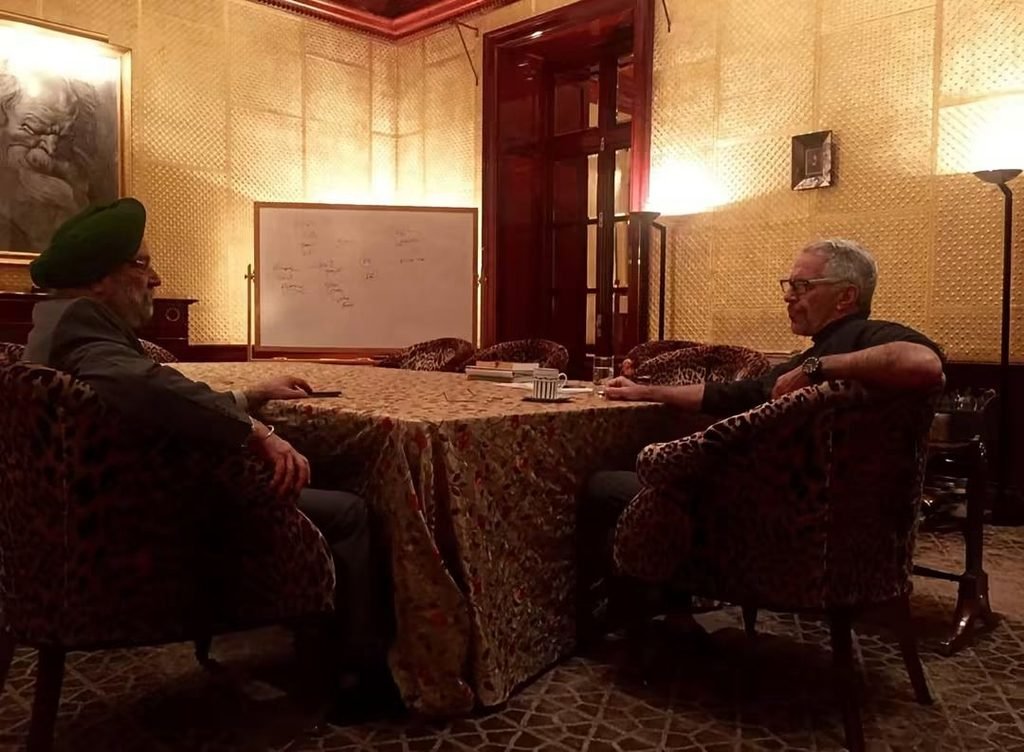
Newly surfaced photographs renew scrutiny of the minister’s association with the convicted sex offender. The central question is no longer whether the two met, but whether Puri’s explanations adequately account for the documentary record. The Modi government must clarify where it stands on ministerial accountability.
NEW DELHI: Political accountability is tested not merely by the existence of incriminating evidence, but by the willingness of those in public office to confront uncomfortable questions with candour, consistency and verifiable facts. The renewed scrutiny of Union Petroleum Minister Hardeep Singh Puri’s association with Jeffrey Epstein, the convicted sex offender whose network extended into some of the most influential circles in international politics, business and public life, presents precisely such a test.
Photographs released by the United States Department of Justice as part of the Epstein files show Puri seated opposite Epstein across a table, with no other individual visible within the frame. According to a report by a media organisation, the relevant dataset contains at least ten photographs of what appears to be the same meeting, captured from slightly different angles.
The images have revived questions about the nature of Puri’s interactions with Epstein and the adequacy of the explanations offered by the minister and his office. The issue is not whether the two men knew each other. Puri has acknowledged meeting Epstein on several occasions. The more consequential question is whether the minister’s public account sufficiently explains the extent, context and character of those interactions.
An association is not proof of complicity. Yet neither does the absence of established criminal wrongdoing extinguish the obligation to provide a credible account of a relationship that has become a matter of legitimate public concern.
The Problem Is Not the Photograph Alone, but the Questions It Revives
At a press conference on February 11, Puri said he had met Epstein three times, or at most four, over several years. He explained that his introduction to Epstein followed his association with the International Peace Institute (IPI), where his then-boss, senior Norwegian diplomat Terje Rød-Larsen, already knew the financier.
Puri described his initial encounter as part of an IPI delegation. Following the circulation of the photographs, however, his office said that the minister could not recall which meeting the images depicted or whether other individuals had been present before or after the photographs were taken. It also maintained that Puri had never claimed he had not met Epstein alone.
These statements require careful interpretation. A photograph showing two individuals does not establish that no one else attended the meeting. Equally, the inability to recall the circumstances of a particular encounter does not, by itself, establish that anything improper occurred.
The difficulty lies elsewhere. When a senior minister’s association with a convicted sex offender is documented through photographs and correspondence, general assurances about professional engagement cannot be expected to resolve every legitimate question.
If the meetings were entirely professional, as Puri’s office maintains, the most persuasive response would be a detailed account grounded in the available records. What were the objectives of the meetings? Who participated? What was discussed? And how did the interactions fit within the minister’s professional responsibilities at the time?
These are not inherently partisan questions. They are questions of public accountability.
Emails Provide a Wider Context for the Association
The photographs constitute only one part of the documentary record. According to a report published by a media organisation on February 1, email correspondence between Puri and Epstein extended from June 2014 to June 2017. The records reportedly document arrangements for three meetings at Epstein’s Manhattan residence, scheduled for February 4, 2015, January 6, 2016, and May 19, 2017.
The correspondence also records discussions concerning India’s internet economy and its investment potential. In September 2014, Epstein introduced Puri to LinkedIn co-founder Reid Hoffman. Puri subsequently communicated with Hoffman about opportunities in India’s digital economy, referring to the government’s Digital India initiative and the potential for technology companies to expand in the country.
Puri’s office has characterised these interactions as professional engagements intended to generate international interest in India’s economic and technological potential. It has argued that the correspondence supports the minister’s account of the purpose of his association with Epstein.
The emails, however, document exchanges beyond investment discussions.
In October 2014, Epstein sought assistance in arranging an Indian visa for an assistant who wished to attend a wedding in India. Puri forwarded the request to former Indian diplomat Parmod Bajaj, asking that the matter be handled on a priority basis.
In December 2014, Puri wrote to Epstein asking him to get in touch after returning from his “exotic island”. He expressed an interest in meeting for a conversation and bringing books intended to stimulate Epstein’s interest in India. A subsequent message included a casual remark encouraging Epstein to contact him upon his return.
None of these exchanges, considered independently, establishes criminal conduct or proves that the interactions were improper. Their significance lies in the fuller picture they provide of an association that extended over several years and encompassed multiple forms of communication.
That record deserves an explanation proportionate to the questions it raises. Describing an association as professional is a characterisation of its nature, not a substitute for establishing that nature through a coherent account of the available evidence.
International Precedents and the Politics of Accountability
The Epstein scandal has demonstrated how associations with a disgraced individual can become questions of institutional credibility, particularly when those involved occupy positions of considerable influence. Several prominent figures have faced dismissal, resignation or the loss of prestigious positions amid disclosures concerning their connections with Epstein.
Peter Mandelson, the former British minister and ambassador to the United States, was removed from his diplomatic position amid controversy surrounding his relationship with Epstein and the emergence of related correspondence. In February 2026, he also relinquished his Labour Party membership and his seat in the House of Lords. Documents concerning his association raised additional questions about the alleged exchange of government information, distinguishing his case from one involving meetings alone.
Andrew Mountbatten-Windsor, formerly known as Prince Andrew, has faced prolonged scrutiny over his association with Epstein. In 2025, the removal of his royal and military honours was announced. In February 2026, he was arrested in connection with an investigation into alleged misconduct in public office. His circumstances involve distinct allegations and legal questions and cannot be treated as equivalent to those surrounding Puri.
In the United States, Leon Black, co-founder of Apollo Global Management, resigned as the company’s chairman and chief executive in 2021 amid scrutiny of payments made to Epstein and the controversy surrounding their financial relationship. Black denied participating in Epstein’s criminal activities.
These cases differ in their facts, legal implications and institutional settings. They do not establish that every individual who met Epstein bears responsibility for his crimes. Nor do they provide grounds for presuming wrongdoing on Puri’s part.
Their broader significance is institutional rather than accusatory. They illustrate that, in certain circumstances, the consequences of an association may extend beyond criminal liability to questions of judgment, credibility and the capacity to retain public or professional confidence.
The relevant question, therefore, is not whether Puri’s circumstances are identical to those of these individuals. They are not. It is whether the standards of transparency and accountability applied to India’s public officials are sufficiently robust to withstand scrutiny when the individual concerned belongs to the highest levels of government.
The Modi Government Cannot Treat Accountability as an Opposition Demand
Puri occupies a senior position in the Union Cabinet and heads a ministry of considerable economic and strategic importance. His responsibilities therefore extend beyond defending his personal reputation. They include maintaining public confidence in the integrity and transparency of the office he holds.
No responsible assessment should infer criminal complicity from photographs or email correspondence alone. Equally, it would be a mistake to reduce the entire controversy to the question of whether a prosecutable offence has been established.
The ethics of public office encompass obligations that are not exhausted by criminal law. Ministers are expected to exercise judgment, maintain transparency where legitimate public interests are involved, and provide credible explanations when their conduct or public statements come under scrutiny.
This distinction is fundamental to democratic accountability. Criminal liability is a matter for the appropriate legal process. Political and ethical responsibility, while subject to its own standards and safeguards, cannot always be deferred until a court reaches a verdict.
Prime Minister Narendra Modi’s government must therefore confront an institutional question: will it consider the minister’s existing explanation sufficient, or will it seek a fuller account of the documented interactions and the questions that remain unresolved?
A credible response would require Puri to address the chronology of his meetings, the circumstances in which they took place, the subjects discussed and the institutional context of the correspondence. Where the records permit clarification, the minister should provide it directly.
Should the questions remain inadequately answered, Puri could consider stepping aside while the matter is examined. The government could also assess whether his continued tenure is consistent with the standards of transparency and ministerial responsibility it expects from those entrusted with public office.
Such a decision would not amount to a declaration of guilt. It would recognise the distinction between determining criminal culpability and protecting the credibility of public institutions.
Congress leader Srinivas B.V. has described the controversy as an “international disgrace” for Prime Minister Modi and his Cabinet. That characterisation represents the opposition’s political response. The more enduring issue, however, concerns the government’s own standards of accountability and whether those standards are applied consistently, irrespective of political affiliation.
Ministerial Office Is a Trust, Not a Personal Entitlement
The appearance of a name in the Epstein files, or a photograph documenting a meeting with him, does not establish criminal wrongdoing. But neither should the absence of such proof become a rationale for dismissing legitimate questions about the public record.
Puri’s office maintains that the interactions were professional and related to India’s economic and technological interests. That position deserves to be assessed against the available documentary evidence, rather than accepted or rejected on political grounds.
The minister should provide a comprehensive and verifiable explanation of his association with Epstein. If the meetings were consistent with the professional objectives he has described, transparency offers the clearest means of establishing that context and addressing public concern.
The government, in turn, must demonstrate that accountability is not a standard invoked selectively against political opponents while being relaxed for those within its own ranks. The credibility of democratic institutions depends not only on the enforcement of criminal law, but also on the willingness of public officials to submit their conduct to legitimate scrutiny.
Puri’s immediate responsibility is to answer the questions arising from the documented record. If he cannot provide an adequate explanation, stepping aside would be a responsible course to consider while those questions are examined. The government, for its part, must decide whether retaining him in office without a fuller resolution of the controversy is consistent with its own standards of public accountability.
The ultimate test is not whether a minister can survive a political controversy. It is whether the institutions he serves can demonstrate that public office carries obligations greater than the preservation of an individual’s position.
In a democracy, ministerial office is held in trust, not owned as a personal entitlement. When that trust comes under serious scrutiny, the burden is not merely to deny wrongdoing, but to provide an explanation commensurate with the public interest.
Abhishek Pandey
Editor, Gujarat Exclusive
