
Investigation | BharatNet Phase-3 in Gujarat: Administrative Failure or Institutional Inertia?
From ISP/TSP Exclusion to a ₹4,700-Crore Turnover Threshold, GFGNL’s Tender Conditions Face Judicial Scrutiny
By Abhishek Pandey | Gandhinagar
When the Government Had to Defend Its Tender Conditions Before the High Court
The BharatNet Phase-3 procurement process in Gujarat has moved beyond administrative delays and repeated extensions of bid-submission deadlines. The eligibility conditions governing the tender are now under challenge before the Gujarat High Court, where the government’s submissions and the documents placed before the bench have come under close scrutiny. During one hearing, Justice Nikhil S. Kariel made the pointed oral observation, “Categorically fool us!”, reflecting the court’s dissatisfaction with the explanations being offered.
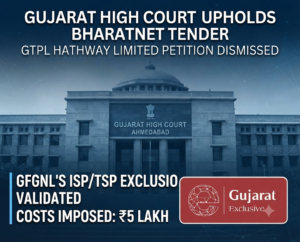
In the final week of September 2026, GTPL Hathway Limited filed Special Civil Application No. 13907/2026 before the Gujarat High Court, challenging certain conditions in the revised tender issued by Gujarat Fibre Grid Network Limited (GFGNL). The petition questions the exclusion of ISP/TSP licensees operating under the Gujarat Licensing Service Area (LSA), the requirement of an average annual turnover of ₹4,700 crore, and the stipulation that bidders must have experience in constructing at least 30,000 kilometres of optical fibre network.
The dispute extends beyond the eligibility of an individual company. It raises a broader question: why were such restrictive qualification criteria prescribed for a ₹5,631-crore national infrastructure project, potentially excluding several experienced companies from the bidding process? Nine companies had participated in the first tender issued in 2025. In the revised 2026 tender, available information suggests that the number of companies meeting the new eligibility requirements has fallen to around two.
The developments have brought GFGNL’s procurement process, its administrative decisions and the use of public funds under scrutiny.
1. A Sharp Exchange in the High Court: The Bench’s Remark, “Categorically fool us!”
The petition concerning BharatNet Phase-3 came before a division bench of the Gujarat High Court, where the petitioner and the government contested the tender conditions, subsequent amendments and the documentary basis for the decisions behind them.
The matter was heard by a bench comprising Acting Chief Justice Manish Ranjan Pathak and Justice Nikhil S. Kariel. Senior advocates Mihir Thakore, Dhaval Vyas and Dhruvin Dosani appeared for the petitioner. Advocate General Kamal Trivedi and the Government Pleader represented the State and other respondents.
During the proceedings, the government presented its submissions on changes to the tender, delays in the procurement process and the disputed eligibility provisions. According to the available account of the hearing, Justice Kariel expressed dissatisfaction with the government’s explanation, making the pointed oral observation: “Categorically fool us!”
The remark came amid questions about the administrative basis for incorporating the disputed tender provisions and the records supporting that decision. The court sought to know why the conditions had been introduced and where the material relating to the decision could be found.
Documents submitted in a sealed cover also became part of the proceedings. The court directed that the sealed cover be opened and the documents placed in the custody of the Court Master. The question nevertheless remained whether the material explaining the decision to incorporate the disputed provisions had been placed before the bench.
The central issue is straightforward: when such significant changes are made to tender eligibility criteria, what administrative decision, technical assessment or policy rationale supports them?
2. From 24 September to 30 October: How the High Court Proceedings Unfolded
Hearings in the case continued from the final week of September 2026. The sequence of events recorded in the court orders provides an account of how the dispute over the tender conditions and the documents supporting them progressed.
24 September 2026: The petition came before the court when the tender deadline was scheduled for September 25. To demonstrate its bona fides, the petitioner voluntarily offered to deposit ₹5 lakh with the court. The sealed cover submitted by the government was opened, and the documents were ordered to be kept in the custody of the Court Master. During the hearing, government counsel informed the bench that the tender deadline had been extended to September 28.
29 September 2026: In its order, the court recorded that, despite the hearing on September 28, the material relating to the decision to incorporate the disputed clauses had not been placed before it. The bench observed that the documents explaining the basis of the decision were still absent from the record. Notice was subsequently issued. At the Advocate General’s request, the matter was listed for a later date. The Government Pleader assured the court that the tender period would be extended until the next hearing.
7, 12 and 15 October 2026: Hearings continued on these dates, with the matter listed as part-heard. The petitioner filed an additional affidavit, while the respondents submitted their replies. The interim arrangement already in force was continued.
30 October 2026: The division bench scheduled the next hearing for November 6, 2026. It also directed that the interim relief granted earlier would remain in force until the next hearing.
The tender dispute has therefore entered a significant stage of judicial scrutiny. The questions before the court concern not only the eligibility conditions but also the administrative decisions and supporting material on which those conditions were based.
3. ISP/TSP Licensees Excluded: No Such Reference in the Central Approval, So Why Did GFGNL Add the Restriction?
One of the principal points of contention is a provision in the revised Request for Proposal (RFP) that disqualifies ISP/TSP licence or authorisation holders operating under the Gujarat LSA from participating in the tender.
The petitioner contends that this restriction was incorporated into the revised RFP issued by GFGNL in June 2026, although the earlier policy documents relevant to the programme contained no such exclusion.
Union Cabinet approval of 4 August 2023: The Union Cabinet approved the Amended BharatNet Programme (ABP) on August 4, 2023. The petitioner argues that the documents relating to the Cabinet approval did not prescribe any restriction barring a particular category of ISP/TSP licensees from participating in the tender.
This raises a significant question: if the programme approved at the central level did not specify such an exclusion, what was the basis for introducing it into Gujarat’s BharatNet Phase-3 tender?
Addendum dated 10 July 2026: According to the petitioner, prospective bidders raised objections to the ISP/TSP restriction during the pre-bid meeting held in June 2026. Subsequently, an addendum dated July 10, 2026, was issued to the original agreement. It refers to the incorporation of the relevant provision under Schedule-II, Part-B, Paragraph 1.13.
The sequence raises a further question. Why was an addendum to the original agreement considered necessary after the tender had already been issued and prospective bidders had objected to the restriction? Was the exclusion part of an established policy from the outset, or was it introduced during the procurement process?
The issue matters because excluding ISP/TSP licensees potentially shuts out companies already operating in the telecommunications and internet services sectors, narrowing the field of competition.
4. From ₹1,200 Crore to ₹4,700 Crore: Why Was the Turnover Threshold Raised So Sharply?
The second major area of dispute concerns the financial eligibility criteria.
In the first tender issued in 2025, the average annual turnover requirement for a single package was approximately ₹1,200 crore. In the revised 2026 tender, the threshold was raised to ₹4,700 crore, calculated on the basis of an average over three years.
That represents an increase of nearly fourfold. Against a total project cost of ₹5,631 crore, an average annual turnover requirement of ₹4,700 crore establishes a particularly high financial threshold.
The Union Finance Ministry’s Manual for Procurement of Goods emphasises that eligibility criteria should be proportionate to the size, nature and risks of a contract. Against that framework, the question is what financial and technical assessment GFGNL relied on to arrive at the ₹4,700-crore threshold.
Did the project’s actual requirements warrant such a high level of financial capacity? Were experienced companies with lower turnover necessarily incapable of executing the work? And did the revised criterion have the effect of excluding established market participants from the competition?
Experience in constructing a 30,000-kilometre OFC network: The revised tender also requires bidders to demonstrate experience in constructing at least 30,000 kilometres of optical fibre cable (OFC) network, or experience in executing related works valued at ₹1,200 crore.
Taken together, the turnover and technical experience requirements significantly narrow the pool of eligible bidders. The question is what specific technical assessment and procurement rationale led GFGNL to prescribe these thresholds.
5. Nine Bidders in 2025, Only Two in 2026: How Did Competition Narrow So Dramatically?
One of the most consequential aspects of the dispute concerns the number of companies able to participate in the tender.
The first tender in 2025: Nine companies participated in the initial tender issued by GFGNL. They included firms operating in the telecommunications, infrastructure and network construction sectors. Their participation indicated a broader field of potential competition.
The revised tender in 2026: According to the information available, the number of companies meeting the revised financial and technical eligibility requirements has fallen to just two. Larsen & Toubro (L&T) and NCC Limited are among the companies identified as meeting the criteria.
The reported reduction from nine companies to two raises an important question: how did the eligibility framework become so restrictive? Did GFGNL assess how many existing market participants would be excluded before revising the conditions?
When competition for a public infrastructure contract is concentrated among a small number of bidders, the implications extend to price discovery and the transparency of public procurement. A wider field of qualified bidders generally gives the procuring authority a better opportunity to secure competitive pricing and services.
The issue, therefore, is not confined to the commercial interests of individual companies. It concerns the cost of the project and the stewardship of public funds.
6. ₹32 Crore Every Quarter to Maintain the Old Network: Who Is Paying for the Delay?
Delays in the BharatNet Phase-3 procurement and its implementation also carry a financial cost. Until the new tender is implemented, the Gujarat government must continue to bear the cost of operating and maintaining the existing BharatNet Phase-2 network.
According to information received from sources, approximately ₹32 crore is being spent every quarter on the operation and maintenance of the Phase-2 network in Gujarat, including payments to ITI Limited and GTPL.
At that rate, the average daily expenditure on maintaining the existing network exceeds ₹35 lakh. This is the recurring cost of keeping the old infrastructure operational while the new project remains pending.
Government counsel refers to a daily loss of ₹15 lakh: During the court proceedings, government counsel referred to a loss of approximately ₹15 lakh a day. The figure is significant because it introduces another dimension of the project’s financial impact into the judicial record.
Combined burden, including cost escalation, estimated at ₹50 lakh a day: The delay of more than a year has also affected the costs of fibre-optic cables, routers, hardware and logistics. According to assessments by financial experts, the combined impact of expenditure on maintaining the existing network and the increase in project costs is estimated to impose a financial burden of approximately ₹50 lakh a day on the state.
The delay, therefore, is not merely a matter of lost time. It has direct implications for government expenditure and the use of public resources.
If central assistance of ₹5,631 crore has been earmarked for BharatNet Phase-3, why has the procurement process been held up by repeated delays and disputed administrative decisions? Who is accountable for the continuing expenditure on the old network and the escalation in the cost of the new project?
A programme intended to improve digital connectivity in rural areas should not leave the public exchequer bearing the recurring cost of delays in its implementation.
7. Questions Before the High Court: Where Does Accountability Lie?
The BharatNet Phase-3 procurement process in Gujarat now faces a series of serious questions. The tender’s eligibility conditions have undergone substantial changes. ISP/TSP licensees have been excluded, the turnover threshold has been raised from approximately ₹1,200 crore to ₹4,700 crore, and bidders have been required to demonstrate experience in constructing a 30,000-kilometre OFC network.
Following these changes, available information indicates that the number of companies meeting the eligibility requirements has fallen from nine in the 2025 tender to two in the revised process. Meanwhile, the operation and maintenance of the existing network is costing approximately ₹32 crore every quarter. The financial consequences of the delay have also featured in the High Court proceedings.
The bench’s oral observation, “Categorically fool us!”, underscores the seriousness of the questions raised during the hearings. The court has sought the administrative basis for the disputed provisions and the documents supporting the decisions behind them. The matter remains pending, with the next hearing scheduled for November 6, 2026.
The questions now extend beyond who drafted the tender conditions. They concern the administrative and technical rationale behind them, how a field that attracted nine bidders was reduced to two eligible companies, and why the state continues to bear the financial burden of delays in the procurement process.
When decisions concerning a publicly funded infrastructure project are contested before a constitutional court, transparency and administrative accountability become all the more important.
In the next episode: An examination of the first BharatNet Phase-3 tender issued in 2025. Why was it cancelled despite attracting nine participating companies? What were the reasons behind the cancellation, and how did the decision set the project back by nearly a year?
Key Questions for Consideration
- If the Union Cabinet approval of 4 August 2023 did not expressly require the exclusion of ISP/TSP licensees, on what basis did GFGNL introduce the restriction?
- Who approved the decision to raise the turnover threshold from approximately ₹1,200 crore to ₹4,700 crore and require experience in constructing a 30,000-kilometre OFC network? What technical and financial assessment supported these criteria?
- Nine companies participated in the 2025 tender, while information about the revised tender suggests that only two companies meet the new eligibility requirements. Did the revised criteria have the effect of restricting competition?
- Who is accountable for the expenditure of approximately ₹32 crore every quarter on maintaining the existing BharatNet Phase-2 network while the Phase-3 project remains delayed?
- Will GFGNL and the Gujarat government disclose the administrative decisions, technical assessments and supporting records on which the disputed eligibility conditions were based?
The investigation continues…
Reference: Amended BharatNet Programme (ABP), Phase-3, Gujarat.
Case Reference: GTPL Hathway Limited v. GFGNL and others, Special Civil Application No. 13907/2026, Gujarat High Court.
ગુજરાતીમાં વાંચો: Episode 3: ભારતનેટ ટેન્ડર વિવાદ હાઈકોર્ટમાં


Discourse / 1
Episode 4: BharatNet Tender Scrapped, A Year Lost – Gujarat Exclusive
November 8, 2026 at 1:16 pm
[…] Under British Scrutiny: Lobbying and Diplomacy GUJARAT: Vadtal Dham’s Unique Initiative GUJARAT: Episode 3: Questions Mount Over GFGNL’s BharatNet Tender GUJARAT: Episode 2: 22 Deadlines, One Tender and a Series of Shifting Decisions CRIME: Crime […]